1. Background
Grape (Vitis vinifera L.) is one of the export-oriented fruit crops grown on an area of about 1.76 lakh hectares with an annual production of 39.1 lakh metric tonnes while average productivity of 8.9 MT/Acre. The two major grape-growing states in India with their share include Maharashtra (63.7%) and Karnataka (31.4%). Maharashtra is the leading state with major cultivation clusters located in Nashik, Solapur, Sangli, Pune, Satara, Jalna and Ahmednagar districts.
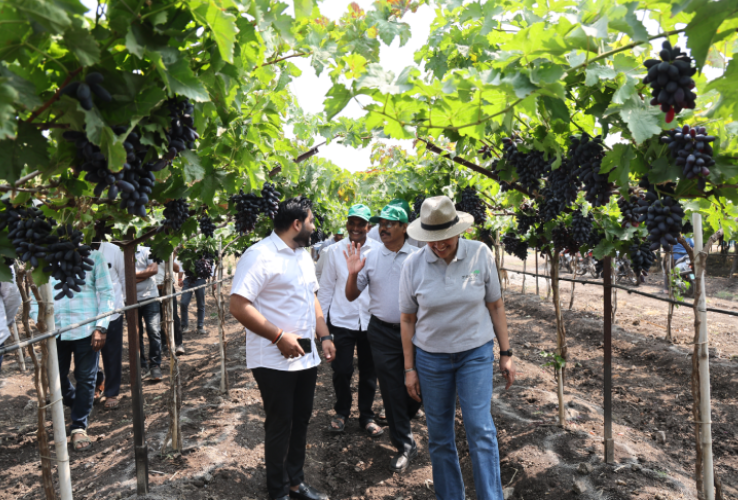
For sustainable and high-quality grape production, efficient management of water, soil, nutrients, pests and diseases is essential. The biotic and abiotic stresses significantly affect grape yield and quality. It is been observed that during the last five years, the grape industry is facing problems related to climate change. Drought conditions coupled with high rainfall, low temperature, unseasonal rains, etc has resulted into increase in production cost while reduction in yield and quality in the grape vineyard. Hence, in order to produce good quality grapes, a scientific approach has become the need of the hour.
Adoption of modern agricultural technologies has become increasingly important to improve grape yield and quality. Timely soil testing ensures balanced and precise fertilizer application while soil moisture sensors help to optimize irrigation scheduling. Advanced tools based on multispectral imaging technology enable monitoring of specific vineyard areas for deficiencies and facilitating site-specific applications thereby reducing input costs and improving productivity. Furthermore, weather forecasting and crop stage-specific advisory help farmers to plan vineyard operations and minimize climate-related risks. Regular field visits by experts and technical guidance during critical growth stages also support farmers in improving vineyard performance.
Considering this, the package of technologies available with MeeroLabs, Mumbai, were implemented at grape growers’ fields during the year 2025-26. Two grape vineyard of were selected for the study in Sangli distric in Maharashtra. Each vineyard was divided into two plots i.e., Control plot (with farmers current practice) and Treated plot (with Meerolabs technologies). Extensive data was collected at three stages under the guidance of a retired Principal Scientist from National Research Centre for Grapes, Pune.
During the period of study, excellent results were obtained with Drone imaging and other modern technologies deployed for managing soil, irrigation and biotic and abiotic stress on the trial plots. These results are summarized below.
2. Impact of the intervention on the Treated plot:
2.1.
Vine growth:
The efficient management of irrigation water and nutrient using IoT sensors in the grape vineyard resulted in controlled vigour. This had direct impact on grape quality and disease incidence.
2.2.
Water consumption:
There was drastic reduction in irrigation water consumption upto 34% to 40% in the two fields.
2.3.
Quality:
The overall grape quality from the treated plot was superior as compared to the control plots. All the critical parameters of quality, namely berry length and diameter, average berry weight, average bunch weight and TSS (total soluble solids) were better in the treated plots.
2.4.
Overall Output:
The overall output increased in both the treated plots.
a) Plot A: From 19.9 tons to 22.3 tons per acre (increase of about 12%)
b) Plot B: From 17.1 tons to 20.6 tons per acre (increase of about 20%)
2.5.
Disease Incidence:
The disease incidence in the treated plot was considerably lower as compared to the control plot. Equally, the pest infestation was lower. Controlled vigour and balanced canopy contributed to this lower incidence.
2.6.
Cost of cultivation:
Reduction in the production cost per acre for nutrients and pesticide led to a saving of Rs 41,500/- (18%) at Plot A and Rs 43,000/- (17%) at Plot B.
2.7.
Increase in Overall Earnings:
The combined impact of increased output, better selling price due to better quality, and reduction in cost with lower disease incidence, better fertilizer utilization and reduced water consumption was as below.
Plot A: Total earning increased from Rs. 10.95 lakhs to Rs. 14.53 lakhs per acre (33%).
Plot B: Total earning increased from Rs. 15.36 lakhs to Rs. 20.62 lakhs per acre (34%).
The overall impact of Meerolabs technology package for grapes is quite large on the overall earnings. Despite last year being a challenging crop season with unusual weather and unseasonal rain due to climate change, the farmers could increase their productivity, earnings and benefits by implementing advanced technology and tools. From the above results, it can be concluded that use of advanced technologies is the only way to fight climate change.